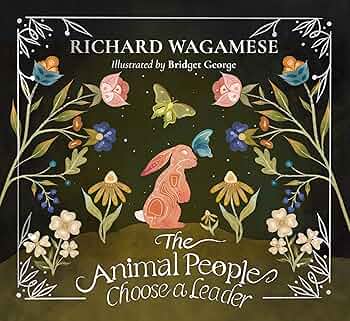
For this post, I will be reflecting on a read aloud that me and my co-teaching partner Graham Smith did over 3 weeks in a grade 6 class. The book we read was “The Animal People Choose a Leader”, by Richard Wagamese.
Below, you will see a read aloud template that we completed for this book before going into the class so we could plan activities, front load questions, and areas to stop/explain some words.
Read Aloud Planning Template
| Title of Text: The Animal People Choose Their Leader, written by Richard Wagamese and illustrated by Bridget George | |
| Background Knowledge -What worldview is this book referencing? Which nation? Where is this? Ojibwe worldview/Nation “Ontario” | |
| Funds of Knowledge -Indigenous storytelling conventions/recurring characters across various nations’ Legends -The purpose that Legends serve in transmitting and reinforcing cultural teachings | |
| Potential Stumbling Blocks -Timeframe (before the emergence of Ojibwe humans?) -Switches in language (e.g., rabbit/Waabooz) -Unfamiliar animals (e.g., buffalo, cougar, wolverine) -Unfamiliar cultural context and physical setting (story takes place in an area most students likely have not been to, landscape includes bogs, blackberry thickets, rock faces) | |
| Instructional Opportunities -The courtesy of introductions (demonstrated with book’s creators by introducing people and homelands together) -Who is Richard Wagamese (as an author and a person) -Bridget George’s art style (influences and origins) | |
| Brainstorm Unfamiliar Words Ojibwe: -Waabooz -Ojibwe! -Ajidimo -Creator English: -Stamina -Discerning -Conferred | ||||
| Words to Teach | Short, Simple, Straightforward Definitions | Words to Explain | Short, Simple, Straightforward Definitions | |
| Attributes | Good qualities or characteristics | Ajidimo | Ojibwe word for Red Squirrel, it means “tail in the air” | |
| Stamina | The ability to do something hard for a long time, Buffalo need stamina to cross plains to graze | Discerning | Making careful decisions between things | |
| Creator | In Ojibwe, Creator is the being, the energy, that created Mother Earth and the humans. A bit similar to how some people think of God in other religions. | Conferred | Had a conversation | |
| Haunches | (Back legs) Rabbits sit on back legs “periscoping” when they are getting a good view of their surroundings | Terrain | Landscape | |
| Crevice (is anyone here a rock climber?) | A very narrow split in a rock face, usually dangerous to climb | Throng | A busy, energetic grouping | |
| Thicket | (When lots of blackberry vines mesh together, like Velcro, Graham got stuck in one once and had to call for help!) | Solemnly | Seriously | |
| Bog | A freshwater wetland with decaying plants and mud, common in Ojibwe homelands | Cover (dense cover) | Branches and leaves that are close together | |
| Territory | Not just a place, but the place the animal come from that they call home, somewhere they are connected to | Hampered | Got in the way of something | |
| A Teaching | An important piece of knowledge that gets passed down through generations | Chasm | A deep crack in the Earth, the edge is like the edge of a cliff | |
| Relent | To let go, give up | |||
| Mired | Stuck | |||
| Leisure | Enjoyment, easiness | |||
| Think Alouds -“I wondered how to say this word, so I looked for a pronunciation video on youtube to help me” | ||||
| Stopping or Pausing Points 1. Animals set off for race 2. Trust 3. End of book | I Language | |||
| Social-Emotional Learning Engagement Desirable and undesirable qualities in leaders Leadership and cooperation strategies | |
| Cross-Curricular Extensions Animal and plant biology Social studies-Indigenous studies (Ojibwe cultural values) | |
| Extensions to Support Reading and Writing | |
| Introduction: Author Richard Wagamese is Ojibwe, from the Wabaseemoong (wah BAH see MOONG) Nation, illustrator Bridget George is Anishinaabe from Kettle and Stony Point First Nations (all nations mentioned are in “Ontario”) Activity #1: What are the qualities we look for in a leader? Ask students to brainstorm which attributes they would like their leaders to have and which they would NOT like a leader to have Write in a T-chart on the board Split students into groups of 2 or 3, teachers choose a leader for each group, give that leader a task to lead their teammates in doing, while the leader demonstrates the positive attributes identified by the class ACTIVITIES: 1. Drawing a simple picture 2. Leading a team member with their eyes closed through “obstacle course” 3. Human knot (Students stand in circle and grab hands of 2 other students across the circle. They must work together to untangle themselves. For this to be successful, you will need to listen to each other and allow others to take the lead) 4. Helium stick (5 students will place a finger on a metre stick – or something like this – and must work together to try to place it on the ground with no one letting go or you must restart) Swap activities, swap leaders, try while leader demonstrates the negative qualities identified by the class – what worked and what didn’t? | |
| Activity #2: Record words to draw a map of the race (while you listen), then draw the map after, compare with a partner? Teacher BEFORE STORY reviews with students: Who are the characters? What did they decide to do? Where are they going? Invite students to think first, THEN raise hands to answer Explain: we will be creating maps later. To create the maps, we will write down words we hear as the story is told that help us picture the SETTING Teachers model this: in front of class on whiteboard EXPLAIN tricky words from the section, write on board Story starts doc cam/reading aloud, students write their words down Teachers model creating the OUTLINES of maps based on word lists on whiteboard, emphasizing that at the end of the section we don’t have details YET about the full lake loop- this means we can do some PREDICTING of what the rest of loop might look like based on cues from the book THEN invite students to do the same PAUSE: turn and talk to a person beside you, share one thing you like about their map and one question you have about their map for 2 minutes PAUSE: teachers model for students adding new ideas to the original map and adding extra details- colours, textures, etc. Prompt students to add the new ideas they gathered and extra details 20 minutes ish? Turn and talk again: one new thing you noticed in their map, one thing your maps have in common, one thing that makes your maps different Invite students to share with the class if they would like to | |
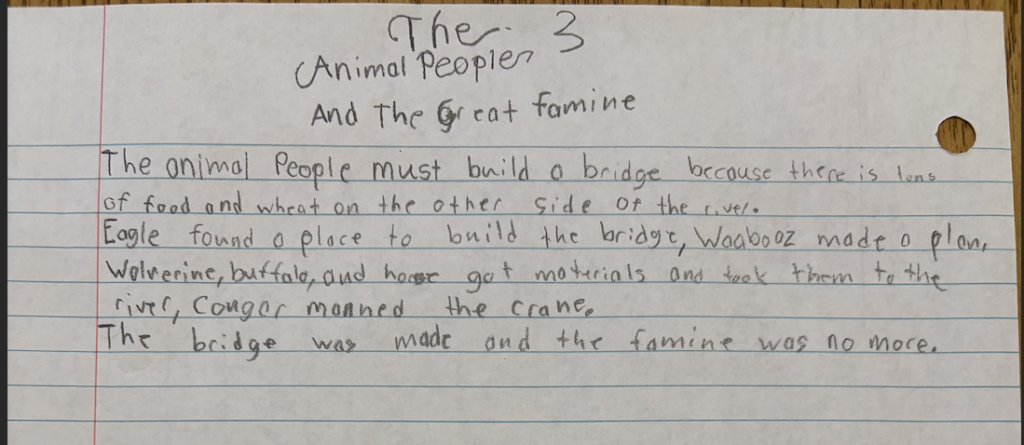
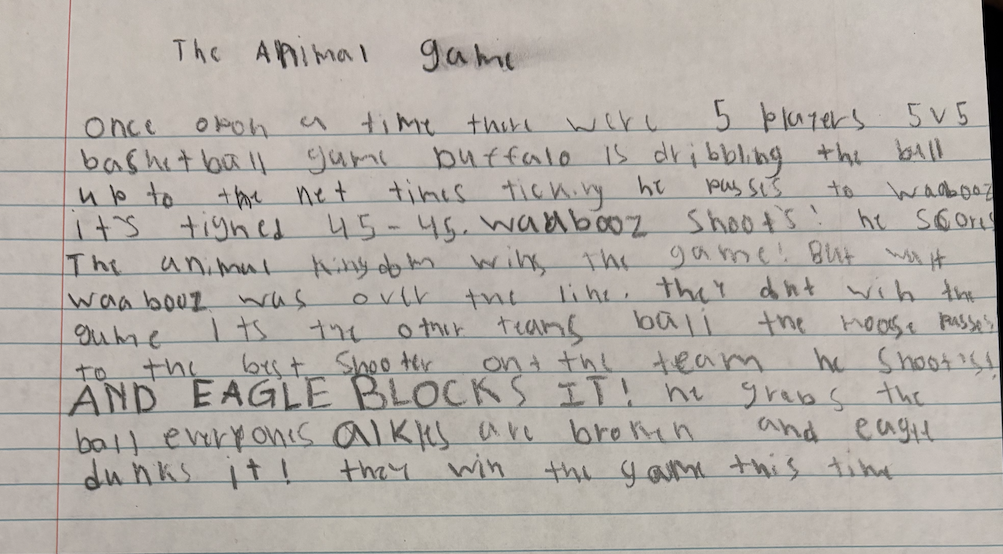
| Activity #3: Activity 2 continued until map is finished? Written Component – What comes next? Ask students what they think these quotes mean. Give them time to think before asking on students to share. “There is no failure when judgement does not exist” “Trust does not require certainty” Using the same characters and their newly found leadership, create an issue that arises that the Animal People must solve. Write it like the next chapter of this story. (Because this story is so well written and powerful, instead of “rewriting the ending” I decided to use what we know from the story and build onto it). Use your imaginations and what you know from the characters. Buffalo – Strong/Proud/Stamina Horse – Speed/Strength Waabooz – Observer/Wise/Critical Thinker Eagle – Messenger/Sees things from different angles Wolverine -Fiesty/Tries his best Cougar – Discerning manner – Careful thoughtful decision maker/patience Wolf – Powerful Presence Model example: The Animal People must build a house. It is getting into the winter season, and the Animal People want a warm place to be able hang out with each other while drinking hot cocoa and tea. It is still the summer, but this is the best time to build it before everything gets too cold and everyone becomes too busy. The cougar with his discerning manner and Waabooz being so wise were tasked to create the blueprints. Eagle scouted and chose the perfect place in the middle of the forest where there was an opening the perfect size for a house and communicated the dimensions for Cougar and Waabooz to finish the blueprints. Wolf and Wolverine then dug out the landscape to be able to build the house with a basement. Buffalo, Wolverine, and Horse carried all the supplies to the location where they wanted to build the house. They spent the next 2 months building the house all together, the horse worked very fast for short periods of time, the buffalo spent many extra hours working because he had lots of stamina to be able to carry on for a while longer than the other. Waabooz finished the interior of the house with paint and decorating. All the animal people worked together to build a place where they could all gather and hangout in the winter while staying warm. |
Reflection:
We co taught the first lesson and then Graham did activity 2 and I did activity 3. All of these activities engaged students and allowed us to dive deeper into the story. I did not get pictures of the first 2 days but I did get a couple examples of the written component Activity 3:
Example 1:
Example 2:
Curriculum Connections:
These activities were following the BC Curriculum for grade 6 ELA and Social Studies.
Big Ideas: Language and text can be a source of creativity and joy. Exploring stories and other texts helps us understand ourselves and make connections to others and to the world. Exploring and sharing multiple perspectives extends our thinking. Developing our understanding of how language works allows us to use it purposefully. Questioning what we hear, read, and view contributes to our ability to be educated and engaged citizens
Curricular Competencies: Think critically, creatively, and reflectively to explore ideas within, between, and beyond texts. Recognize and identify the role of personal, social, and cultural contexts, values, and perspectives in texts. Recognize how language constructs personal, social, and cultural identity. Construct meaningful personal connections between self, text, and world. Recognize and appreciate the role of story, narrative, and oral tradition in expressing First Peoples perspectives, values, beliefs, and points of view.
Content: Story, Strategies, Language Features